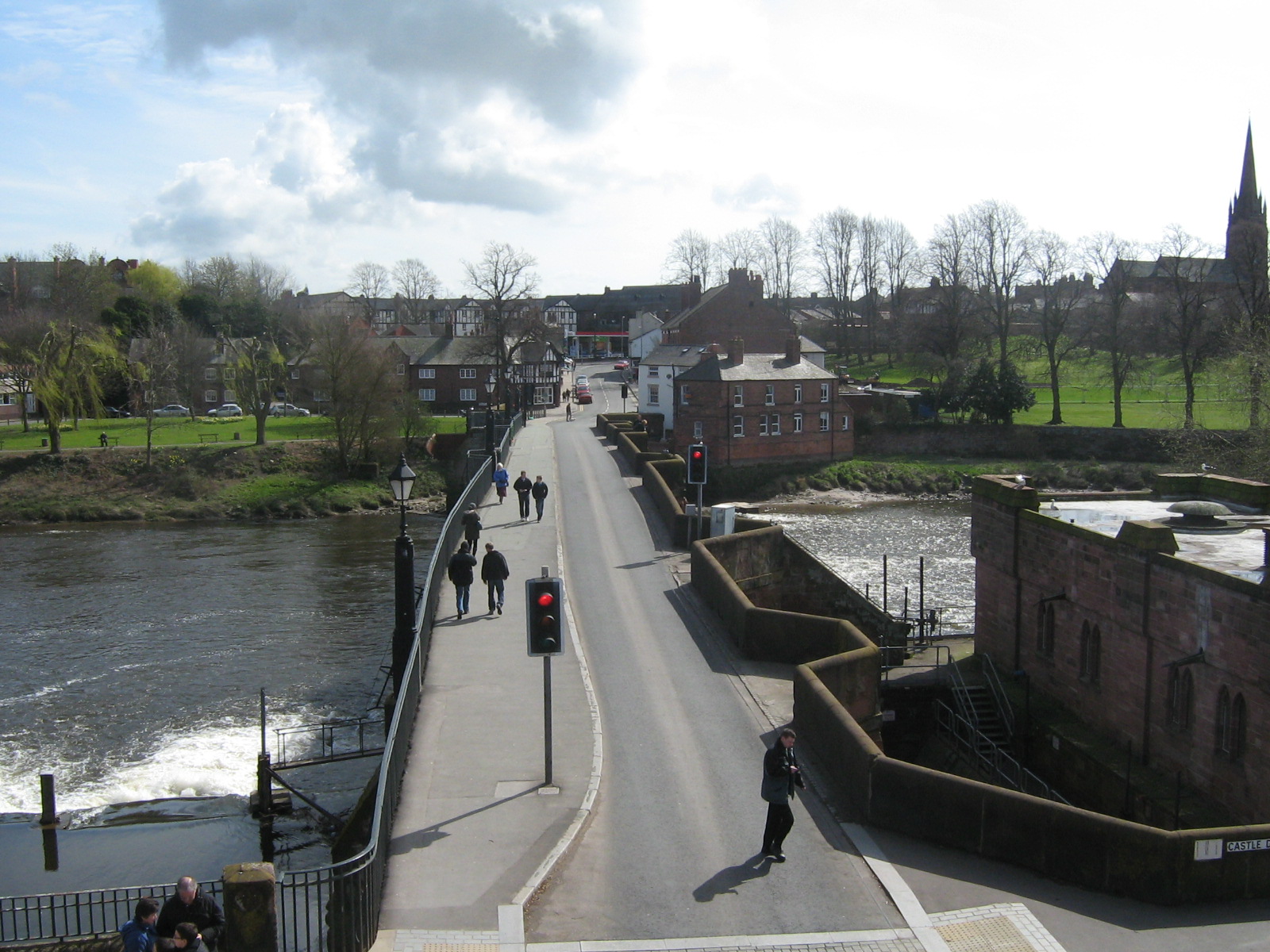
Above you see the view from the house of the Ladies of Llangollen near Llangollen in Wales, not far from Chester. (The double "l"s are pronounced a bit like a Scottish "ch", as in "loch", or the German "ch" as in "ach" or "Eichmann". So, "Chlangochlan". Sort of.) The Ladies were two "romantic friends" as they were called - who set up house here in 1780 in what was regarded as a cottage. They called it Plas Newydd (New Place - one could imagine more exciting names, but it was their house) and panelled the inside with lots of bits of mediaeval carved wood from churches, old houses and so on. The wooden fancy bits on the outside were added by a subsequent owner though the Ladies had the porches made. They were actually Anglo-Irish and their families didn't approve of their relationship, though later accepted the inevitable and gave them an allowance. The Ladies became quite famous, though not for actually doing anything as far as I can tell, and they were visited by various distinguised people of the day.
Monday, April 12, 2010
Houses and gardens
Above you see the view from the house of the Ladies of Llangollen near Llangollen in Wales, not far from Chester. (The double "l"s are pronounced a bit like a Scottish "ch", as in "loch", or the German "ch" as in "ach" or "Eichmann". So, "Chlangochlan". Sort of.) The Ladies were two "romantic friends" as they were called - who set up house here in 1780 in what was regarded as a cottage. They called it Plas Newydd (New Place - one could imagine more exciting names, but it was their house) and panelled the inside with lots of bits of mediaeval carved wood from churches, old houses and so on. The wooden fancy bits on the outside were added by a subsequent owner though the Ladies had the porches made. They were actually Anglo-Irish and their families didn't approve of their relationship, though later accepted the inevitable and gave them an allowance. The Ladies became quite famous, though not for actually doing anything as far as I can tell, and they were visited by various distinguised people of the day.
Sunday, April 11, 2010
Chester
Quite elderly.
Gosh, it's hard on the feet, though: trotting round a city all day.
More exciting holidays snaps coming soon.
Saturday, April 10, 2010
Holiday
Sunday, April 04, 2010
Easter
Friday, April 02, 2010
Fifty years ago
Fifty years ago, I was nine and three-quarters and in Miss Harvey’s class. The previous year I’d been in Miss Dickson’s. She was in her thirties, I’d say - a brisk, cheerful woman with those winged glasses fashionable in the 50s and very tidy, almost childlike handwriting. I liked her, though looking back I think she was probably an organised rather than a very motivational teacher. But she inspired confidence. And I was a good girl, quiet and shy but eager to please, with neat writing and good spelling.
But when I was nine our teacher was Miss Harvey, who had a big face, an amused expression and a deep voice with an English accent. On the first day of the school year, a new girl whom I’d been told to look after asked me a question while Miss Harvey was talking. I whispered an answer. Miss Harvey asked me my name and told me that I was "obviously going to be a trouble-maker". I was completely cowed and thought from then on that this was her view of me. So that was the whole year ruined. I expect that Miss Harvey actually forgot what she’d said to me about ten seconds after she’d said it but I didn’t realise that at the time.
That was the year I stopped doing my homework – not because of this incident, I don’t suppose; just because it was so boring – and didn’t really start working again at school till my final, pre-university year. I just coasted along, cushioned by my ability to read quite fast and to write, spell and punctuate accurately. I had a reasonable memory and was good enough at sums. However, I lived my life anxious that someone would notice my lack of diligence, though no one ever seemed to. My reports tended to say that I lacked confidence. This was true, but mainly because I hadn’t done the work and was having to improvise quite a lot.
At home, when I was nine, we lived in a bungalow which had had two bedrooms and a toilet built into the attic space for my brother and me. My bedroom had a long window overlooking the garden, which was quite big (by British standards) with lawns, flowerbeds and apple trees. My passion for gardening started there. I loved to tilt lupin leaves so that raindrops ran down the grooves and gathered in the centres, shining like jewels. I used to bury my face in carnations and pinks to drink in their fragrance. And lilac blossom – blissful scent, still probably my favourite. I loved the daffodils cheerfully piercing through grass beneath the trees; the furry beards of iris, their velvety petals and bright colours; the sharp yellow and orange of nasturtiums and the squeaky feeling of their leaves.
I was quite a solitary child, I think, though not actually lonely - just because there were very few children living nearby and I spent a lot of time reading or daydreaming or wandering round the garden. My brother was (is) two years eight months older and though we got on well, our interests were very different and I don’t remember our playing together. He knew a lot more than me about everything and was my main source of information about things that I didn’t necessarily want to ask our parents.
I attended a school in the centre of the town and so my school friends didn’t live nearby. My best friend at that time was Dorothy, who was to be killed in Brussels at the age of twenty-three when a car mounted the pavement that she was walking along. Dorothy was the class golden girl: blonde and pretty and sensible. She always got sent on any errands to other teachers – an enviable task, since the messenger got to wander about the empty corridors, looking through the glass panels at other classes. Though Dorothy was my best friend, I was aware that I was only one of her best friends: she was popular with the other children as well as with the teachers. She and I used to go swimming on Saturdays at the chilly public baths at Portobello. I think the water was slightly heated but the air certainly wasn’t, and we shivered violently when we came out, pulling our clothes over our not-properly-dried bodies in our desperation to get warm again. Then we would go to the cafeteria, which was empty and draughty, offering very little. But if we were lucky an assistant might come out from somewhere and sell us a hot buttered roll for two pence (or tuppence, as we called it). They were so delicious: white rolls (we always had brown bread at home) with the butter just melting. These post-swimming warming snacks were called “chittery bites” or in Standard English, “shivery bites”. Then we’d go up to my house or hers and play dressing-up. I still miss Dorothy and wonder what she would have done with her life. We stayed friends and I got a letter from her the week before she died, telling me how much she was enjoying life in Brussels. She's for ever twenty-three while the rest of us... are not.
Fifty years… how unimaginably old my nine-year-old self would have thought the fifty-nine-year old version if she’d met her. Older than her mum; not much younger than one of her grannies; older, much older than Miss Dickson and Miss Harvey. And yet - still the same person in most ways.
So: what were you like when you were nine?
Tuesday, March 30, 2010
Chilly chilly chilly
I've finished marking my huge heap of essays, which were not (alas) startlingly good but which featured (alack) not all that many sillinesses for your delectation. I can offer you only:
Some scientists say that it's a sign of global warming that the glaziers are retreating.
The way tha't the theme effect's the characters in this story...
He is being sartistic and dimsife.
(No, I don't really know what she meant either. I assume "sarcastic and dismissive".)
Saturday, March 27, 2010
That was the week
On the same day, our son-in-law's grandfather died.
We heard that our son has been offered a job (he's a junior doctor and there's a strange, rather random system for giving out jobs) for July onwards for the next two years, but it's not where he wants to be - and his girlfriend wasn't allocated one - so he's going to turn it down. There will be more jobs on offer at a later stage but who knows if there will be a suitable one? Or indeed two. They may decide to do locum work for a while.
My mother fell down on getting out of the bath twice this week and couldn't get up for a while. One of these nights, I was in the house with her but she didn't call out because she didn't want to bother me.
So. A week of mixed emotions. One day, life will be plain sailing. You think?
Saturday, March 20, 2010
More bloggish musings
What is the function of your blog? I’ve mused on this question before but it’s an interesting one. (Or at least I think it is.)
One of the function of mine is to record my life. For me. Not that I’m claiming that it’s a particularly interesting or significant one – but it’s the only one I have and I want to preserve it. I’m struck by the fact that I occasionally look back to see what I was doing this month two years ago, for example, and come across things that I’d more or less forgotten about – not huge life events, obviously, but amusing little snippets or enjoyable visits or whatever. I also like looking back to see what the garden was doing at this time in another year.
For this reason, I wish that I’d had a blog when the children were little. All those jewelled mummy moments that Stomper Girl, for instance, records on hers – lots of mine are probably forgotten by me because they were never documented. On the other hand, I do have more recent bloggy bits from when ours were still at home and I’m glad of that.
Another blog function is to communicate. I love the feeling of scattering words and being aware of them landing in people’s heads in distant lands. Now, I think we all feel that while quietly chuntering to ourselves is satisfying, it’s more so if people leave comments, making the communication two-way. It’s striking (to me) how many people read without commenting. I hardly ever do this. Somehow I feel as if I have to earn my pleasure in reading by at least waving hello. I think “lurking” suggests the slightly underhand sensation one gets from merely reading. And yet of course it’s a free world, this Blogdom. If we don’t want people to have access to our burblings, we shouldn’t publish them.
The only times I don’t comment are when there’s nothing I feel I can say – when I really don’t agree with what people are saying/doing (and this applies to very few people I read); or if there are already so many comments that there’s nothing to add.
My fourth blog birthday passed at the beginning of March and, reading back, I’m struck by how much sadder my life is now than it was then. Then, the children were all at home (including our soon-to-be son-in-law), my father was still alive, my mother was reasonably independent. Now the offspring have flown, my father’s dead and I spend a lot of time supporting my mum who, while amazing for nearly 88, is getting gradually frailer. I do still have Mr Life (a fine chap and I’m grateful for him). But I feel my life has changed from colourful to sepia. It's all right, day to day. But only all right.
I say all this because of the third function of my blog: not really to canvass sympathy, despite the pathetic tones of the previous paragraph, but to force myself to clarify my thoughts more publicly – and therefore possibly more coherently – than I do when just gently musing. I’m not really one to bewail my lot and then expect angels to descend from the sky and sort things out. (Though this would be handy.) My children aren’t responsible for my happiness. I have to find a way of being happy, some point to my life. And it needs to be a bit more than just getting up, breathing a lot, teaching, marking and then going to bed again.
Thursday, March 18, 2010
Kittens and things
A couple of thoughts from the essays:
1. "Stanhope was a hypochondriac with many imaginative illnesses."
(Yes, I've come heard about some imaginative illnesses in my time from students who haven't been in class.)
2. [Quoting from a poem]: "The deck piled high with bodies - this doesn't sound like a very pretty picture."
(Well, no.)
Tuesday, March 16, 2010
Wise sayings
(The picture is not of J but of Daughter 1's guinea pig Pumpkin. Look at the light of intelligence in her eyes. )
Friday, March 12, 2010
What IS it that makes good writing good?

Ok, this is my last self-indulgent English-teachery pontification about writing for the moment. Oh, how easy it is to criticise and oh, how hard it is to do well!
With Anne Tyler, what I didn’t really mention was the way she turns phrases – because I was writing at work while supervising exams (they didn’t need a close eye…) and I didn’t have the book with me. But now I have.
Here’s the opening of “A Patchwork Planet”:
“I am a man you can trust, is how my customers view me. Or at least, I’m guessing it is. Why else would they hand me their house keys before they leave for vacation? Why else would they depend on me to clear their attics for them, heave their air conditioners into their windows every spring, lug their excess furniture to their basements? “Mind your step, young fellow, that’s Hepplewhite,” Mrs Rodney says, and then she goes into her kitchen to brew a pot of tea. I could get up to anything in that basement. I could unlock the outside door so as to slip back in overnight and rummage through all she owns – her Hepplewhite desk and her Japanese lacquer jewelry box and the six potbellied drawers of her dining-room buffet. Not that I would. But she doesn’t know that. She just assumes it. She takes it for granted that I’m a good person.
Come to think of it, I’m the one who doesn’t take it for granted.”
That first sentence is quite clumsy – deliberately so, I’m sure. It sounds like a man musing, considering the situation. AT could have written, “My customers trust me” or “My customers see me as a man they can trust” – and that would have been okay. But I like the way she’s set up the ambivalence from the start with the declaration followed by the qualification: he is – or is he not? – a man to be trusted. Trust is one of the key themes of the novel.
Then that “Why else…?” repetition shows that he’s keen to be trusted – but perhaps can hardly believe that he is. He examines the evidence: a list of tasks that he’s trusted to do in people’s homes. This also neatly conveys the speaker’s job: he’s a manual worker – look at those verbs: “clear… heave… lug”. His youth is made obvious by Mrs Rodney’s “young fellow”. Then the repetition again: “I could… I could….” – we feel him almost luxuriating in the possibility of that “rummaging” as he lists the items he could look through. Then the paragraph ends with those four short, emphatic sentences: “Not that I would. But she doesn’t know that. She just assumes it. She takes it for granted that I’m a good person.” And we wonder: is he so emphatic because this is true, or because he wants us to think that it’s true, or because he’s trying to convince himself that it’s true? I also like that rather naïve wording – “a good person”, as if it were an absolute; as if everyone fell into one or other category, good or bad.
And then there’s that last, one-sentence paragraph: “Come to think of it, I’m the one who doesn’t take it for granted.” Here AT makes his self-doubt clear and leaves the reader intrigues as to why he’s so concerned about whether or not he’s good.
Ah, what a pedant I am: 313 words to discuss AT’s 169.
Now here’s the beginning of “My Sister’s Keeper”:
“When I was little, the great mystery to me wasn’t how babies were made, but why. The mechanics I understood – my older brother Jesse had filled me in – although at the time I was sure he’d heard half of it wrong. Other kids my age were busy looking up the words p____ and v_____ * in the classroom dictionary when the teacher had her back turned, but I paid attention to different details. Like why some mothers had only one child, while other families seemed to multiply before your eyes. Or how the new girl in school, Sedona, told anyone who’d listen that she was named for the place her parents had been vacationing when they made her. (Good thing they weren’t staying in Jersey City, my father used to say.)”
* JP doesn’t use dashes but I don’t want my blog to attract the wrong sort of comments….
Ach, it really annoys me that I can’t quite analyse what’s wrong with this. Indeed, there’s nothing wrong. She writes well, and I apologise to anyone who really likes JP – I’d love to have as much success as she’s had by writing. (Or any other way, come to that.) She’s good. This first paragraph does the job. It sounds reasonably like a young person talking (though not, in my opinion, a 13-year-old as it’s supposed to be), the rhythm is fine, it sets the situation up all right. There’s a bit of humour, though it’s the joke we’ve probably all made about the Parises of this world.
But it’s a bit… ordinary. Workmanlike – workwomanlike. Clear. Fluent. But it doesn’t make my heart sing.
Anyway. I’ll shut up now and get back to posting about cats.
Thursday, March 11, 2010
Anne Tyler

So, let’s be more positive. Anne Tyler – why is she so good?
I think this is quite an interesting question. I think we all find that our piffle detectors work quite well – Jodie Picoult yes, Anne Tyler no – but I personally sometimes find it difficult to work out exactly what tips a novel over into the piffle area. JP writes very fluently; it’s not that she’s not articulate. Her novel has a plot, quite a complicated one. Why is AT wonderful and JP pot-boilerish?
In my opinion, Anne Tyler’s novels convince because they deal with ordinary people who have little quirks which one has come across or could imagine that one might. These characters would be interesting even without a plot, but they usually find themselves in just slightly unusual situations and the reader is intrigued to know what will happen. There are few deaths in her novels (though I can think of a couple); no car chases; no murders or transplants or anything hugely dramatic; and that’s how I like my books. But there are plots, and these plots play out according to the characters’ personalities.
One of my favourite of her novels is “A Patchwork Planet”. The main character and narrator, Barnaby Gaitlin, is about 30 and considers himself the black sheep of his family. Never having been a man, I’m perhaps no judge, but his voice convinces me. He seems to think and speak as such a man might. He’s no saint but he’s an amusing and sympathetic character, often speaking colloquially (he calls someone a “lamebrain”, for instance) but sometimes using vivid descriptions – as when he describes an old lady who’s carrying a small dog “folded over her arm like a waiter’s napkin”.
The unusual aspect of the Gaitlin family is that it’s a very wealthy one – maybe something like a minor version of the Carnegies or the Rockefellers. Their wealth derives from a supposed visit by an angel to Barnaby’s great-great-grandfather to give him advice. The result is that he decided to make his woodenware factory manufacture a hugely successful mannequin called the Twinform - for women to try new outfits on, to see which combinations of clothes and accessories go together.
How did Anne Tyler think this up? This seems to me like real imagination - not just looking in the newspaper to find a current topic which might be exploited.
Barnaby is beginning to think that he should make something of his life, and the novel covers a year in which he makes a stab at changing things. He comes across one of these Twinforms manufactured by his family’s firm, and this becomes a symbol of change – just as women stood back and looked at a new version of themselves, in a new outfit, Barnaby looks metaphorically at himself and his life and decides to remake himself.
He works for an agency called Rent-a-Bak, which people can call up if they want someone with a bit of muscle to shift things around the house. (If only this existed in Edinburgh.) He is anxious (for various reasons) to be trusted, and obviously this is relevant to his job as well as other areas. A lot revolves round the agency – his co-worker is a main character, his boss helps bring about change in Barnaby, his clients come into the story too and prove that they trust him. The other main factor in his life is his family, particularly his mother, who married from a humble background into this wealthy and confident dynasty and who is desperate to conform – and for Barnaby to conform.
I realise that this sounds a bit far-fetched – angels and Twinforms and fortunes. But the characters are totally convincing in their reactions to these admittedly odd situations. Barnaby, for example, sees the angel thing as being eye-rollingly characteristic of his tedious family – and yet he wistfully half-believes that if only he could find his angel, he could be guided to a better way of life. Wouldn’t we all like an angel to wander past from time to time and tell us what we should do?
Anne Tyler prepares so beautifully for everything; it all slots neatly into the structure. And she requires her readers to pay attention. For example, Barnaby tells us early on about a Shakespeare sonnet which is never mentioned again till all of a sudden he speaks a line from it and it tells us exactly what he’s thinking about another character. And there’s a scene near the beginning that takes place at Baltimore Station – and this part of the story doesn’t seem to go anywhere. Until the end, when it suddenly – wonderfully – comically – does. I just love the sense of planning. Characters don’t wander randomly in and out; they work for their places in the novel by having a vital part either in the plot or the characterisation.
I love the way she plays with the reader. At first, Barnaby sounds rather creepy. Then you realise that he’s actually quite good-hearted. Then suddenly she makes him say, “Back in the days when I was a juvenile delinquent…” and you start wondering about him again. I love her little human truths: one client gets Barnaby to haul her Christmas tree down from the attic on New Year’s Eve because her grandchildren are coming and she wants the house to look festive, and Barnaby instantly understands – grandchildren are so important among his older clients. And at one point someone tells an old lady that she looks “youthful” and she thinks for a moment that he said “useful” and is thrilled – because one of the sad things about old age is that we no longer do feel useful.
And I like the way it finishes. Barnaby has moved on to some extent and it looks as if – well, I won’t say what – is going to happen. But things might go a different way. The ends aren’t quite all tied up; some of them are loosely looped and…
One of the reasons why I’m so interested in what differentiates commercial piffle – which may be good in its way – from storytelling that really grabs you is that from time to time in recent years I’ve had little goes at writing novels and then abandoned them because they seem to me to be coming out much nearer the piffle end of the spectrum. And I can’t quite work out how that happens. I’d much rather be Anne Tyler.
Though I’m sure Jodi Picoult is very rich…
Saturday, March 06, 2010
I think, therefore I am a bit confused
Here is the final flourish of the essay. Believe me, it's of much the same standard as the rest.
The poem isn't your typical ryhming poem it is effective in its comparison to real life and what society is like and you can not change life. It seems that nothing has changed in time and there is more voilence outside that every before so the poet is right to think that our society is a bit like the Wild Wild West.* The word choice was very effective giving you a lot to think about when it comes to imagery. Overall the poem had a great contrast and comparisons.
*Note the repetition of "Wild" to add yet one more word of meaningless waffle to this piece.
The good news is that I didn't teach this student. I'm sure my students' exam essays (which someone else will mark) are a lot more insightful and analytical.
You think?
Off I trudge, hoping that the next essay will be a good one. Good ones are so much quicker to mark than bad ones.
(Exit. No bear. Cats)
Wednesday, March 03, 2010
Some of us have to work. Others get to lie in the sun.
From today's batch of essays:
"I feel motivated to follow my hearth." (Me too. It's far too cold to follow anything unheated.)
"This play is about a grizzly murder." (That'll be A Winter's Tale, then, with its stage direction Exit, pursued by a bear.)
Must go and mark some more.
Edited to add, the next day...
What I originally put in my laboured little parenthesis was that the grizzly must have been in Pericles. Then suddenly, this morning at work, a propos of nothing at all, I thought - argh, it's not Pericles, it's A Winter's Tale. So, unable to bear the thought of this silly mistake remaining on my blog, I logged on as myself-at-home - which is a bit of a fiddle when I'm not at home - and rapidly made the change. Only because I was hurrying, I typed A Winer's Tale, which made no sense, or in fact looked as if I was making some ponderous but incomprehensible joke.
Oh, ho, the irony: mocking others for their errors and making TWO myself. Serves me right!
Subscribe to:
Posts (Atom)